The San tribe, one of the most intriguing people in this world, are the region’s earliest inhabitants (it is estimated that they have been living here for the last 30,000+ years) and are still settled in many parts of Southern Africa.
The San people are the first people of Africa. This means the San are descendants of the first people who ever lived here, before black or white people migrated into the African region.
Archaeologists and geneticists agree, that the San are the descendants of the original Homo sapiens groupings, who occupied Southern Africa, for at least 150 000 years.
According to genetic studies and the geneticists: That one of the oldest gene patterns found in some modern humans, is that of the Khoe-San, and it dates back around 80 0000 years.
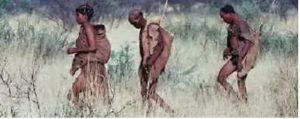

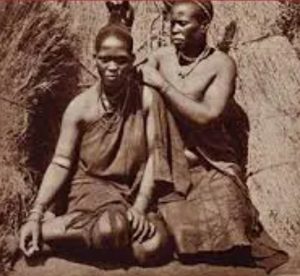


According to history, these are large percentage of humans on earth, are all descendants from this original gene type. The only exception is that of Tanzania’s Hadzabe hunter-gatherers, and the genetic descendants from the Neanderthal and Denisovan genetic groupings.
“From about 25 000 years ago, there is evidence of cultural practices that were still being followed until recently by southern African hunter-gatherers – such as the making of ostrich eggshell beads, shell ornaments, the bow and arrow and rock art.
The migration of homo sapiens out of Africa, took place from about 40 000 years ago, coinciding with the possible acceleration of our language skills. Each group of people who left Africa took with them new language families. At that time all humans were hunters and gatherers.
There is a debate between palaeontologists and linguists about when humans developed to the point that our ancestors were able to pronounce more sounds and with rapid brain development we were able to move into more abstract thought, as represented in our tools and art forms.
This is when we start to see the spread of rock art in Southern Africa.Khoe-San peoples and their descendants were hunter-gatherers until the ancestors of the Khoekhoe acquired domesticated animal stock some where prior to 2 500 years ago.
The Khoekhoe seem to have migrated into South Africa about 2000 years ago either from Namibia or Botswana, bringing with them sheep herding culture, and different social organisation than that common amongst hunter-gatherers.
Typically, hunter-gatherer groups were small, without complex political leadership or any military capacity.
There have been three major waves of genetic, cultural and technological immigration into South Africa: Khoekhoe herders, Bantu speaking agro-pastoralists, and European colonial agro-pastoralists. Each group brought major changes to the lives of the San peoples.
As noted above, the Khoekhoe migrated into the country about 2 500 – 2000 years ago, occupying coastal areas, the southern Cape, and the major rivers, such as the Orange River (called !Garib).
They may have made friends with the San hunters in some cases, but the San also appear to have withdrawn to the mountains and deserts of Southern Africa.
In the !Garib River area archaeologists believe that the San were friends with Einikhoe (possibly from the N|u word Kx’ain, river, drink. Kx’ainikhoen). Later, after European occupation of the Cape, there was conflict with neighbouring peoples.
This included violence between San groups and others such as the Namakhoe, !Orakhoe, Oorlams and Griquas. The San at this time were driven further out of the river areas into remoter areas with less water.
The first Bantu-speaking agriculturalists moved into Southern Africa about 1 800 years ago, with the major migration of agro-pastoralists happening about 800 years ago. The term Bantu developed negative connotations during apartheid
Source: Opera news