…How The Latin American Country Operates The African Monarchical Ruling System For Over 200 Years In The Hidden
By Adeyinka Olaiya/ Brazil
It is nothing but a fact that the world’s most hidden African kingdom is located in the Yungas’ Valley , a forest in the Plurinational state of Bolivia, the Latin American country with a large number of indigenous people.
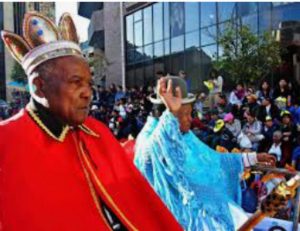
Located in the South American territory, Bolivia counts on La Paz , the highest capital city in the world, having about 3,690m in elevation. A place where the wind blows cold and thin at all times , getting tourists gasping for oxygen in the altitude.
But if you move past the clumsy environment, a bit towards the north-east, descending into the sub-tropical Yungas valleys, you’ll discover a cluster of African styled and quiet villages hidden in the forest of Yungas, a hidden concentration of afro-Bolivians, an African kingdom hidden amid the tapirs, jaguars and spectacled bears.
A remarkable African community that has remained largely unrecognised by the international communities for over 200 years: the Kingdom of the Afro-Bolivians, a spiritual capital of thousands of Bolivians of African descents who worship African deities . It is one of the last African kingdoms in the Americas, a kingdom still in existence.
According to a former Bolivian Parliamentarian an Afro -Bolivian, Jorge Medina, the African ancestors were unable to adapt to the cold weather of Potosí in Bolivia’s southern highlands in the beginning of the 19th Century, so they were relocated by the Spanish colonialists to the warm Yungas to work on the plantation estates. This was the exact period that the African kingdom was unofficial formed ; it was formed in 1820 by a group of enslaved Afro-Bolivians.
Though this African monarchical system has always functioned more like a tribe from the Old Oyo empire in South West Nigeria . It has always observed the African rhythms, musics , dances , worships , dresses , culinary for over 187 years. The kingdom was finally recognised in 2007 by the Bolivian government of the then president, Ivo Morales.
Though in the hidden , the greatest African influence on Bolivian culture is the music , the saya or la saya music . It grows in popularity in Bolivia, but it is still very poorly understood.
No one, except Afro-Bolivians, seems to be able to interpret it. The reason for this lack of understanding is due to the fact that the interpretation of the instruments, as well as the rhythm, is very peculiar.
Saya involves music instruments incorporated into African percussion. The basic instrument is the drum, inherited from African ancestors, together with rattles, maracas and even rattles tied to clothing, in the ankle region.
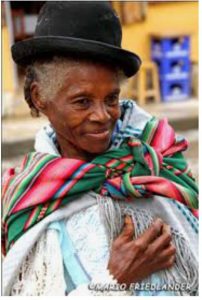
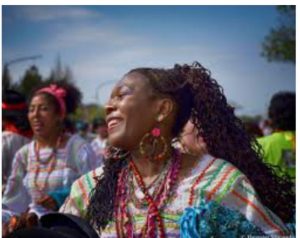
During the presentation of the saya, Afro-Bolivians wear Aymara-style clothing. Women wear a multicolored blouse with feathers, an equally multicolored skirt, called “pollera”, with a blanket in their hands and a bowler hat. Men wear a hat, festive shirt, an aymara-style belt, wool trousers, called “bayeta pants” and sandals.
Each rhythm of the saya begins with the percussion of a bell by the Caporal, who guides the dance. He, also called Foreman, guides the dancers and wears decorated trousers, with bells on the ankles and holds a whip.
The women, who have their own guide during the dance, sing, while moving the chairs, shake their hands and talk to the men, who play the drum and an instrument called coancha.
In an exclusive interview with the king of the kingdom . Rei (king) Júlio Pinedo “ This kingdom is a pride to the African descents in the Americas, It is the only source by which the culture, tradition , and the religion of our Ancestors are kept alive in Bolivia and other parts of the Americas.
This is a struggle of centuries, we thank the gods of our Ancestors that the national visibility given today to our kingdom has helped promote our race and the combat against discrimination.
Before , we were called negritos or negros , but now things have changed, and they’ve started to call us Afros, we worship the gods of our forefathers, we worship the Orisas that our forefathers left behind , Sango lives here, the same Sango of the Oyo empire is worshipped here “ The monarch said.
The king, along with most of his rural subjects, still cultivates coca, sugarcane, bananas and coffee to survive, but more young Afro-Bolivians are going to the universities, and there are plans to improve and encourage more tourism in the area.
The Orisha worship is another significant impact left behind by the African ancestors in the kingdom, the worship of Sango, the Yoruba god of thunder is quite present and observed in houses , places and traditional shrines in Yungas forest since the inception of the African kingdom in Bolivia.
However, several religious beliefs, tribal and ethnic differences and languages have made the kingdom a concentration of all African states and ethnicities.
According to king Julho Pinedo , the kingdom received Slaves from all part of West and Central Africa, the Spanish colonialist brought slaves from Senegal, Congo, Dohomey, Yoruba, Ewe , Ashanti and lots more to work in the plantation . One can hardly point out the dominant tribe as all tribes were mixed together.
Papa Sucre Sousa de Xangó , an Afro-Bolivian and a Sango devotee said “ the situation started in 1544 when the Spanish colonialists discovered silver mines in the city that is today called Potosí, located at the foot of Cerro Rico, in Bolivia.
Almost immediately they started to enslave the indigenous people to work in the mines. However, the health of the indigenous people who worked there was becoming very precarious, which is why the Spaniards started looking for new contingents to serve as labor.
At the beginning of the seventeenth century, mine owners began to bring in large numbers of African slaves to work in the mines, alongside indigenous people who remained healthy.
The African slaves who mostly were from the West Africa mixed up with the indigenous people of the territory to work for the Spanish colonialists in the forest , my forefathers from Dahomey who were of Yoruba tribe were part of them
My forefathers were Xangô devotees and it has passed through several generations till date , that’s why am also Sango devotee ” he concluded.
According to him, the conditions in which slaves had to work were horrible. They did not survive more than six months. Potosí is located at an altitude of approximately 4,200 meters, making it the highest city in the world. Slaves, of course, were not used to working in those conditions.
Their lives were also cut short due to the toxic fumes from the smelters, in addition to the mercury vapors they inhaled. In addition, they had to work in the dark for about four months.
When they finally came out of the mines, they had to put a blindfold on their eyes, to protect them from the sunlight, which they had not seen for a long time.
The kingdom represents the importance and the presence of the African race in Bolivia, the present king is Rei Julio Pinedo who was born on the 19 February 1942 , he is the traditional king of the Afro-Bolivian kingdom of the Nor Yungas province.
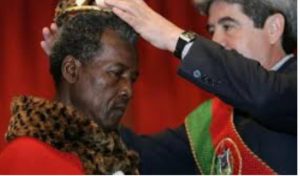
He was crowned in 1992, exactly thirty years after the death of the previous king who was his grandfather , Rei (king) Bonifacio Pinedo. The kingdom and the king was finally given the official recognition in 2007 after 187 years of its existence.
He was sworn in by the Mayor of La Paz and with the presence of the then President of Bolivia , Ivo Morales.
The battle was never an easy one.The Afro-Bolivians freed still had to fight an uphill battle when it came to maintaining their culture. Many of the elements of this began to disappear, such as the festivals, the language and the connection with spirituality.
They had to violently oppose colonial aggression and exclusion, present in the post-emancipation culture. One of the ways to stick to this culture was through its music dance, and the worships.
Buhari is a sworn Fulani loyalist. In spite of complaints by other Nigerian tribes of being marginalized in appointments, Buhari continues to appoint only his kinsmen to run the affairs of Nigeria, a multiethnic country. He is tearing the nation apart more than ever by the day! People whose regions produce the wealth of the nation are being denied appointments, while those regions that are dragging us back are being given most of the appointments. Even their criminals get pats on the back! Pity for Nigeria under Buhari.
Yoruba Nation must surely emerge.